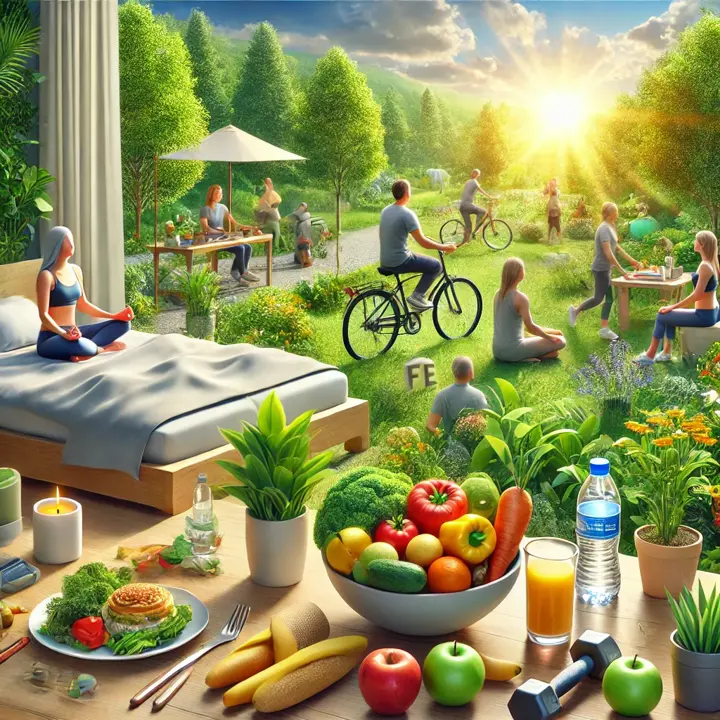
Lifestyle diseases are chronic diseases caused by the way we live our life. Unhealthy lifestyles like smoking, uncontrolled drinking of alcohol, unhealthy diet, and physical inactivity contribute to chronic diseases such as cardiovascular diseases, cancers, respiratory diseases, and diabetes. Chronic diseases are non-communicable diseases as they do not spread from one person to another. Globally, about 75% of all deaths are because of non-communicable diseases. Every year, nearly 43 million people fall prey to non-communicable diseases.1 Cardiovascular disease, cancer, respiratory diseases, and diabetes account for over 80% of all premature non-communicable disease deaths
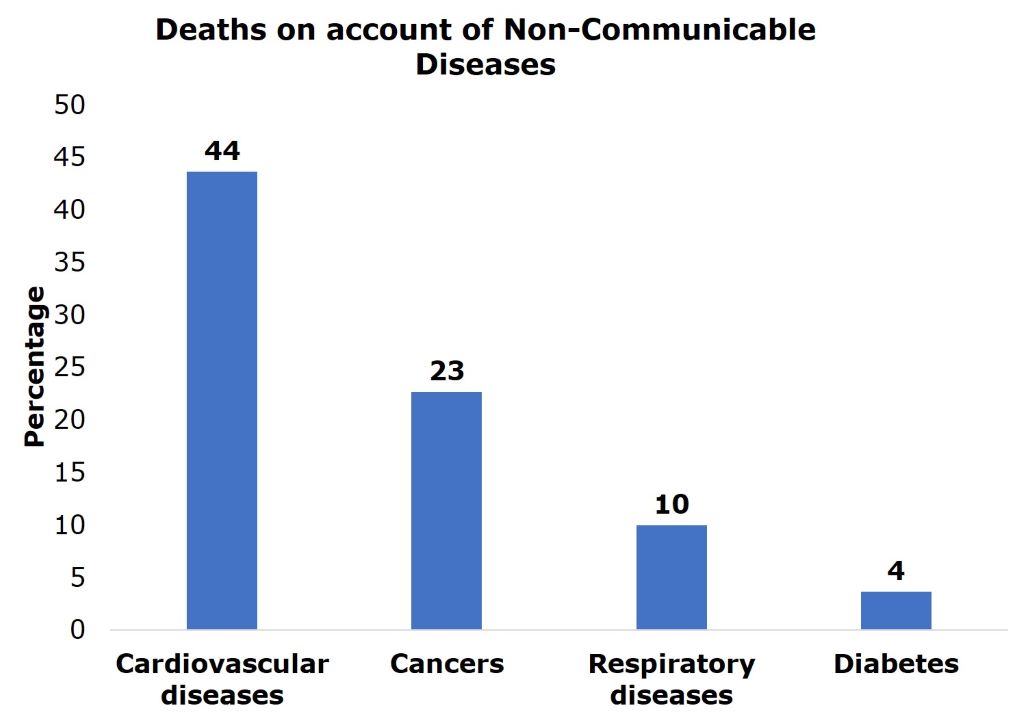
Graph based on the World Health Organization’s factsheet on non-communicable diseases1
Economic burden of lifestyle diseases
According to the information available on the website of Centers for Disease Control and Prevention, heart disease and stroke cost the American healthcare system $233 billion per year and cause $185 billion in lost productivity on the job. The cost of cancer care in America continues to rise and is expected to reach more than $240 billion by 2030. In 2017, the estimated cost of diagnosed diabetes was $413 billion in medical costs and lost productivity.2 As per the 2015 publication of OECD and World Health Organisation3, over 10,000 years of life in good health could be gained in western Europe each year, and even more in central and eastern Europe, at a negligible cost, by limiting children’s exposure to advertising of foods and beverages high in salt, sugar, and fat. Cutting salt intake through regulation and food product reformulation led to a gain of 44,000 life-years in good health in England, with savings in healthcare expenditures largely compensating implementation costs. There could be massive savings if we effectively manage our lifestyle, which in turn could improve productivity.
How can we manage lifestyle diseases
Effective management of lifestyle diseases starts with targeting the major contributing factor of a specific disease and then complementing it with supportive measures on a long-term basis. This approach is good, as lifestyle diseases are chronic; and seldom cured by a single short-term strategy. Following are the general approaches to the effective management of lifestyle diseases.
1) Adopt a healthy lifestyle such as a balanced diet, physical activity, good sleep, and a happy mental state,
2) Use evidence-based quality nutraceuticals as a supplementary measure,
3) Take medicines only under the recommendation and supervision of an experienced medical practitioner. Be it allopathy, Ayurveda, Siddha, or Unani, and
4) Carefully blend two or more of the above approaches depending on the intensity of the disease or health condition.
Healthy lifestyle
Unplanned urbanization, globalization of unhealthy lifestyles, and population aging are the prime driving forces of non-communicable diseases. A healthy lifestyle can reduce the risk of lifestyle diseases and is in the hands of every individual. A healthy lifestyle is a way of living that helps people enjoy more aspects of their life. It is a way of living that lowers the risk of being seriously ill or dying early and is a way of being that help the whole family.4
How to maintain a healthy lifestyle
Consume adequate water, eat healthy food, perform moderate physical activities, sleep enough, and be happy always to maintain a healthy life. Additionally, quit smoking tobacco and avoid drinking excessive alcohol.
How do I know how much water is enough for me
Drinking good quality water is indispensable to our health. We do not need to bother about how much water we need to drink. Just replenish the lost fluid from the body. Water loss happens in the body through urination, sweat, and stools. Pale, odorless, and plentiful urine indicates that we are well-hydrated. Let’s cultivate the habit of drinking water after every loss. This way, we can take care of the body’s daily water requirements. Also, drink water after every food intake, especially if the food taken is dry and solid.
Have good food
Good food, good life. So, eat good food. Some of you may think that I am writing the slogan of Nestle. But I cannot avoid it because it is true. So, what is good food? Good foods provide vital nutrients and energy. Consuming them in adequate amounts each day plays an important role in supporting our immunity. Malnutrition (eating more unhealthy foods or less healthy foods) is the single prime driver of morbidity and mortality in the world, more than tobacco smoking or high blood pressure.5 A dietary consumption evaluation carried out across 195 countries showed the higher intake of sodium, lower intake of whole grains, and a low intake of fruits as the leading dietary risk factors for deaths and disease-adjusted life-years globally and in many countries.6 Therefore, eat a balanced diet including fruits, vegetables, whole grains, legumes, nuts, and seeds with controlled levels of sodium and sugar for good health and to prevent or reduce the risk of lifestyle diseases.
Perform regular physical activities
Irrespective of age and gender, regular physical activity helps to improve overall health, fitness, and quality of life and reduces the risk of chronic diseases like type 2 diabetes, heart disease, many types of cancer, depression, anxiety, and dementia.7 Physical Activity is necessary to stimulate the body’s natural maintenance and repair system. Physical activity helps our bones, joints, and muscles, especially our heart, to stay younger. There are three main components of physical fitness; stamina, strength, and suppleness.4 Stamina helps us keep going without gasping for breath. With stamina, we have a slower, more powerful heartbeat and can cope more easily with prolonged or heavy exercise. Strength is about having well-toned muscles. For example, having our shoulder, trunk, and thigh muscles are toned-up enables us to do physical work without experiencing strains and injuries. Suppleness gives us good mobility, for example, to the neck, spine, and joints. It prevents spraining ligaments, and we will be less likely to experience aches and pains from stiff joints.
One can choose appropriate physical activities from the below graph based on one’s lifestyle and needs to balance strength, stamina, and suppleness. The number in the graph represents the effectiveness of the physical activity. One means a no real effect, two means a beneficial effect, three means a very good effect and four means an excellent effect provided by physical activity.
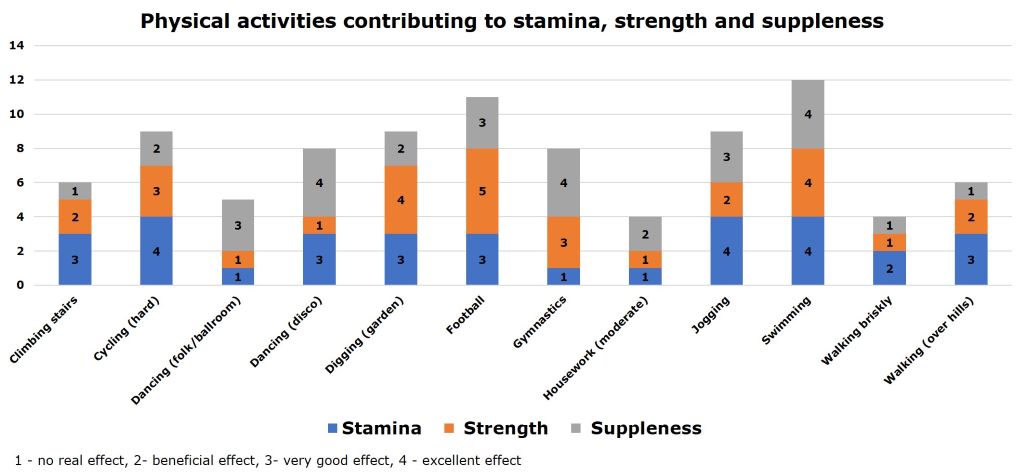
Graph based on the report from Healthy Living (1999) document by the World Health Organization Regional Office for Euorpe4
Sleep well to rejuvenate yourself
Our quality of life depends upon the quality of our sleep. Housekeeping helps to maintain our living place or workplace clean, neat, and well organized, which makes it a good, peaceful, and happy place to stay or work. In the same way, sleep is like housekeeping for the body. It helps to maintain us in a healthy state. When we are asleep, healing and repair of cells take place to rejuvenate our body. The benefits of good sleep include stronger immune system, improved mood and energy, better brain function and healthy growth and development for kids and children. Insufficient sleep in the long run becomes the main entrance to many chronic diseases including type 2 diabetes, cardiovascular disease, obesity, and depression.8,9
Be happy always
Happiness is a state of emotional well-being. It can be called the opposite of feeling stressed. We know that stress is one of the chief reasons behind every disease. Numerous scientific research indicated that subjective well-being reduces morbidity and mortality in general populations and individuals with diseases such as diabetes, cardiovascular diseases, arthritis, and depression. Happy people are more likely to have a healthier lifestyle and better immunity, which in turn reduces the risk of lifestyle diseases and premature mortality. Also, happy people tend to have lower levels of cortisol, cholesterol, and glycated hemoglobin.10
A large Australian study following nearly 10,000 adults found that people who reported higher levels of happiness and satisfaction were more likely to enjoy excellent overall health, remain free from chronic conditions, and maintain stronger physical well-being over time. Importantly, these benefits persisted even after accounting for their initial health status. In short, the study demonstrates that positive psychological states such as happiness and life satisfaction are strong predictors of better self-rated health, physical well-being, and reduced risk of chronic health limitations over time.11
Quit smoking
In the U.S., tobacco smoking has contributed to nearly 1 in 3 cancer deaths,12 90% of lung cancer deaths12 and 80% of chronic obstructive pulmonary disease deaths.13 Smokers are more likely to die from chronic obstructive pulmonary disease than non-smokers. Smoking increased the risk of coronary heart disease by 2 to 4 times14, stroke by 2 to 4 times14, and diabetes by 30-40%.15
Curtail drinking alcohol
Worldwide, 2.6 million deaths resulted from the harmful use of alcohol in 2019, of which 13% of the total deaths are in the age group of 20–39 years.16 Harmful drinking of alcohol is linked with higher risk of conditions like liver cirrhosis (damage to liver cells), pancreatitis (inflammation of the pancreas), cancers including liver, mouth, throat, larynx, and esophagus, and psychological disorders.16,17
To conclude, the way we live our life invites lifestyle diseases. Maintain a healthy lifestyle and do not give any chance for lifestyle diseases to overcome us. Do you know that lifestyle components like a balanced diet, exercise, sleep, and happiness improve immunity? Check this title “Immunity – How can you improve it naturally?” to know more.
References
- World Health Organization. Noncommunicable Diseases. Accessed on 05 February 2026.
- National Center for Chronic Disease Prevention and Health Promotion, Centers for Disease Control and Prevention. Health and Economic Costs of Chronic Diseases. Accessed on 05 February 2026.
- OECD/WHO. Promoting Health, Preventing Disease: The Economic Case, Open University Press – McGraw-Hill, Buckingham, 2015.
- World Health Organization Regional Office for Europe. Healthy Living 1999. Accessed on 05 February 2026.
- World Health Organization. Nutrition in universal health coverage. Geneva: World Health Organization; 2019 (WHO/NMH/NHD/19.24).
- GBD 2017 Diet Collaborators. Health effects of dietary risks in 195 countries, 1990-2017: a systematic analysis for the Global Burden of Disease Study 2017. Lancet 2019, 393(10184):1958-1972.
- Office of Disease Prevention and Health Promotion (n.d). Current guideline – Physical Activity Guidelines for Americans. U.S. Department of Health and Human Services. Accessed on 05 February 2025.
- Ramos AR, Wheaton AG, Johnson DA. Sleep Deprivation, Sleep Disorders, and Chronic Disease. Prev Chronic Dis. 2023 Aug 31;20:E77.
- Antza C, Kostopoulos G, Mostafa S, Nirantharakumar K, Tahrani A. The links between sleep duration, obesity and type 2 diabetes mellitus. J Endocrinol. 2021 Dec 13;252(2):125-141.
- Steptoe A. Happiness and Health. Annu Rev Public Health 2019, 40: 339-359.
- Siahpush M, Spittal M, Singh GK. Happiness and life satisfaction prospectively predict self-rated health, physical health, and the presence of limiting, long-term health conditions. Am J Health Promot. 2008 Sep-Oct;23(1):18-26.
- Centers for Disease Control and Prevention. Health Effects of Cigarettes: Cancer. U.S. Department of Health and Human Services, 17 September 2024. Accessed on 05 February 2026.
- Centers for Disease Control and Prevention. Health Effects of Cigarettes: Chronic Obstructive Pulmonary Disease (COPD). U.S. Department of Health and Human Services, 15 May 2024. Accessed on 05 February 26.
- Centers for Disease Control and Prevention. Health Effects of Cigarettes: Cardiovascular Disease. U.S. Department of Health and Human Services, 17 September 2024. Accessed on 05 February 26.
- Centers for Disease Control and Prevention. Diabetes and smoking. U.S. Department of Health and Human Services, 15 May 2025. Accessed on 05 February 26.
- World Health Organization. Alcohol. 28 June 2024. Accessed on 05 February 26
- Park SH, Kim DJ. Global and regional impacts of alcohol use on public health: Emphasis on alcohol policies. Clin Mol Hepatol. 2020 Oct;26(4):652-661.
Disclaimer: This article is for informational purposes only and is not medical advice. Always consult a qualified healthcare professional for any health-related decisions.




Pingback: Food, Supplements, and Medicines – Are You Using Them Right? - Mythreya Herbal Research Institute